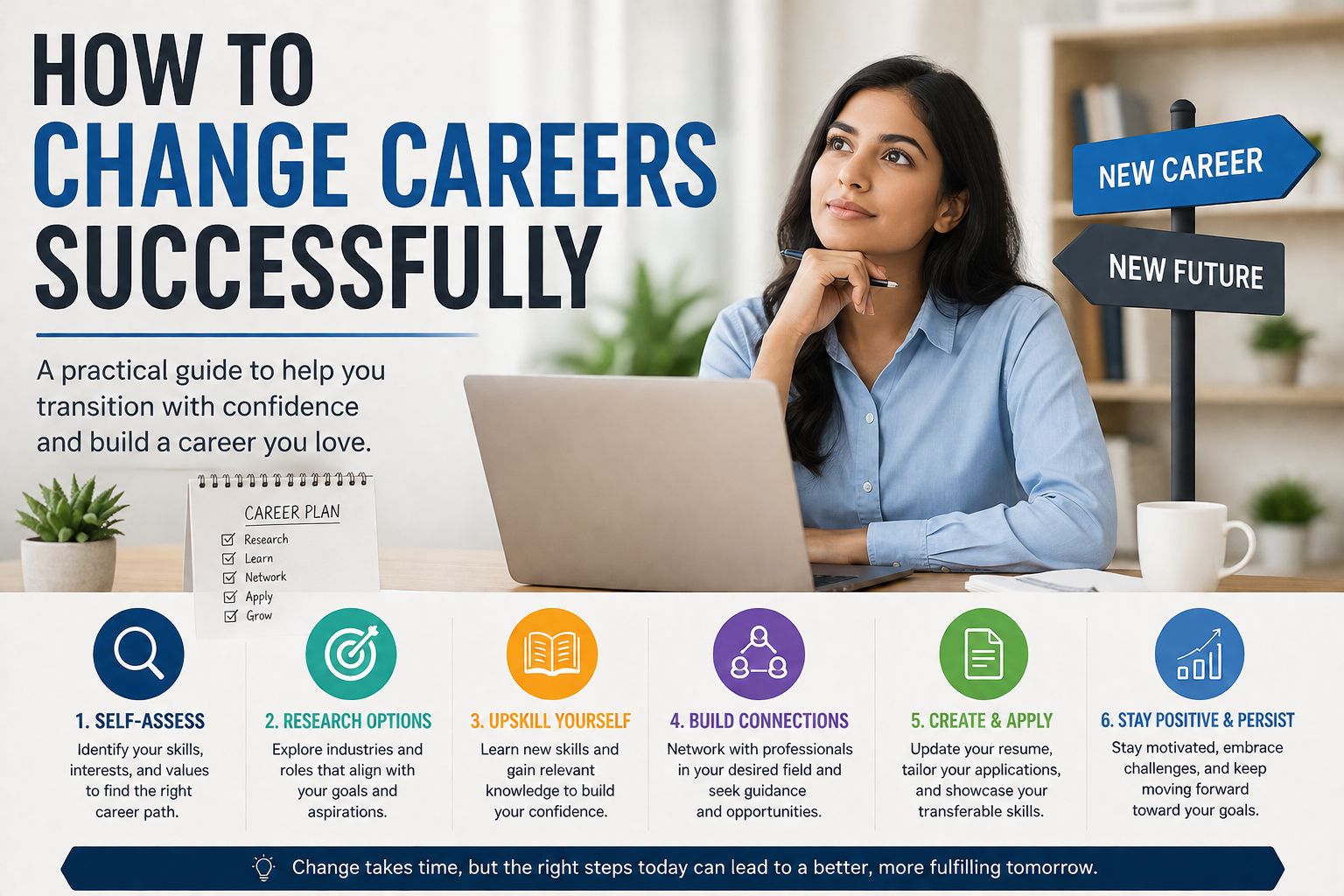
How to Change Careers Successfully – Your 2026 Guide
"Sometimes we get into our careers right after school for various reasons. If you want to make a career change, identify what you love and what you're good at." – Mark Saltrelli, VP of Engineering Recruiting at Kelly
That feeling of being stuck? The dread of another Monday in a role that no longer fits? You're not alone. About half of all Americans are considering a career change, but the fear of starting over holds many back. According to Pew Research Center, 60% of job switchers actually see higher earnings after making the change.
Here's what successful career changers know that you don't: you're not starting from scratch. You're redirecting existing skills to new opportunities. The average person will change careers five to seven times during their lifetime. Your next chapter isn't a reset—it's an evolution.
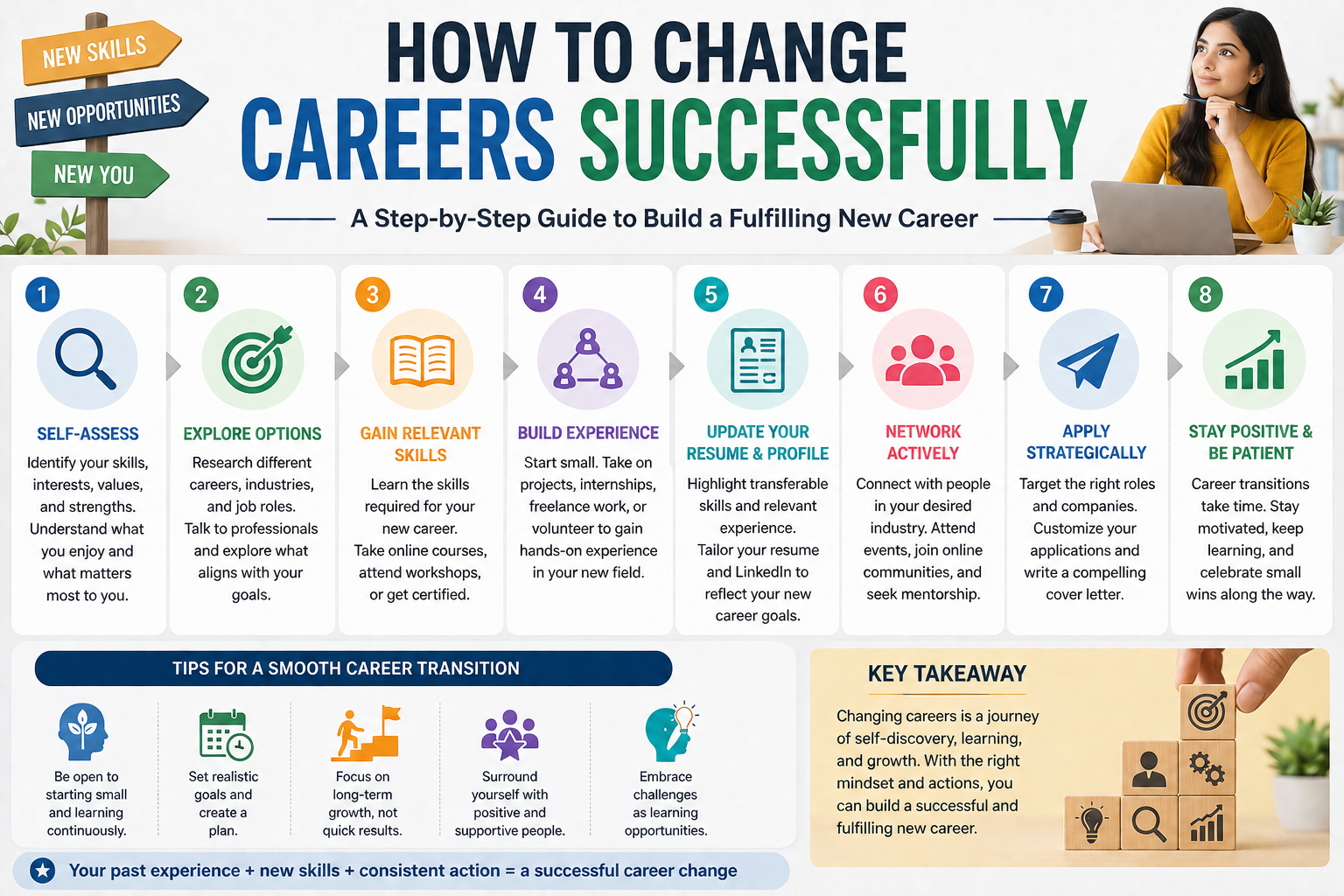
Chapter 1: The Groundwork – Self-Assessment and Research
Start With "Why": Before you update your resume, get clear on what you actually want. Most people get stuck because they focus on what they don't want, rather than figuring out what genuinely motivates them. Start your journey by building a personal brand that reflects your true interests.
Questions to ask yourself:
- What three things do I genuinely enjoy doing?
- What specific skills do those activities require?
- What problems do I actually want to solve?
The "Web Building" Strategy: Career expert Mark Saltrelli recommends a technique called "web building"—taking one core interest and mapping all the ways it translates to paid work. One of his recruiting managers felt trapped in her role until she realized she loved training others. Today, she works in Learning and Development.
Research Your Target Industry: Once you have clarity, do your homework:
- Analyze job descriptions in your target field—what skills and keywords appear repeatedly?
- Read industry publications to understand trends and terminology
- Check growth projections—is this a growing field?
- Use LinkedIn to research companies that hire in your target industry
Chapter 2: The Timeline – How Long Will This Take?
Career transitions take longer than typical job hunts, and the timeline depends heavily on the skills gap between your current role and your targeted position.
Similar fields
A couple of months
Related skills
A few weeks
Complete switch
Months of developmental learning
Three factors drive the timeline:
- How much upskilling you need
- The strength of your network in the target industry
- Market demand for your desired role
The "Sell Yourself" Test: Saltrelli asks career changers one critical question: "If you were interviewed for this specific role today, how would you sell yourself?" If you can't yet, you need more preparation.
Chapter 3: Transferable Skills – Your Secret Weapon
Often the most challenging part of changing careers is explaining how your prior experience translates to an industry you haven't worked in. That's where transferable skills come in.
What Are Transferable Skills? Transferable skills are abilities that are useful across various jobs and industries—like critical thinking, creativity, communication, resilience, and teamwork. Identifying them helps employers see what you'll bring to the role.
What career changers get wrong: They downplay their existing experience. Instead, reframe it strategically.
| Current Role | Transferable Skill | Target Role Application |
|---|---|---|
| Teacher | Curriculum development, facilitation | Corporate trainer, L&D specialist |
| Retail manager | Team leadership, inventory management | Operations manager, project coordinator |
| Software engineer | Problem-solving, systems thinking | Product management, consulting |
Your next step: Review your resume and rewrite your role descriptions to highlight universal, transferable skills.
Chapter 4: Reskilling – Closing the Gap
You don't necessarily need to go back to school for a full degree, but you may need to fill skill gaps.
Options to Bridge the Gap:
| Option | Best For | Examples |
|---|---|---|
| Certifications & Bootcamps | Quick, focused skill acquisition | Google Certificates, AWS, PMP |
| University Study | Deeper knowledge, career credibility | MBA, Master's programs |
| Volunteer Projects | Real experience, portfolio building | Nonprofit work, pro bono consulting |
| Professional Development Courses | Targeted upskilling | Short courses, workshops |
Use Contract Assignments to Build Credibility: "Sometimes you've got to get experience to put experience on the resume," Saltrelli says. Short-term contracts give you experience in a new industry that you can speak to during interviews.
Your next step: Honestly assess the skills you need for your ideal new career. Dedicate the next month to mastery.
Chapter 5: The Career Change Resume
Writing a career change resume can be tricky, but these strategies work:
- Highlight Transferable Skills: Transferable skills are hard skills in demand across many roles. "Never include soft skills on your resume," advises career experts. Soft skills cannot be quantified, so they don't belong there. Instead, focus on "project management," "data analysis," or "budget management."
- Lead with a Value Proposition: Recruiters skim resumes for just 6-8 seconds. Lead with a profile that highlights relevant strengths and transferable achievements—not just job titles, which may not mean anything to a recruiter in a different industry. Emphasize skills like project management, client training, or data analysis.
- Focus on Accomplishments, Not Duties: Employers want to see what you accomplished in previous roles and how those accomplishments could translate to success in their industry.
- Weak: "Responsible for managing team."
- Strong: "Led a 12-member cross-functional team to deliver a $2.1M infrastructure project 3 weeks ahead of schedule, saving $110,000."
- Use the "Additional Experience" section to showcase volunteer work or special projects related to your target industry.
- Create an Interview Bucket List: List 10-20 companies you'd love to work for. Customize your resume for specific openings at these companies, tailoring it for each position.
Chapter 6: The Cover Letter – Tell Your Story
A career change cover letter is different—it should highlight examples from your current experience and explain why they make you suitable for the new role.
What to Include:
- Your motivation for the career shift – Why this change? Why now?
- Transferable skills – Connect the dots between your past and future
- Your enthusiasm – Show genuine interest in the new field
- Any relevant training – Certifications, courses, or projects you've completed
Chapter 7: Networking – Your Highest-Return Activity
Between 60 to 80% of roles aren't advertised. Many opportunities arise from existing contacts and networks.
Strategic Networking That Works:
- For introverts: Start small with realistic goals, like five new LinkedIn connections monthly in your target industry. Send a personalized message about your interest in making a career change.
- Go beyond LinkedIn: Connect with people in your new industry through informational interviews, industry events, and professional groups.
Why Networking in a New Industry Feels Intimidating: It is! But it doesn't require being the most outgoing person in the room. Build relationships strategically and authentically with people who provide valuable insights and opportunities.
Master professional email etiquette to make your networking outreach polished and effective.
Chapter 8: The Interview – Sell Your Potential
Position Your Experience Strategically: Career changers often make the mistake of downplaying their existing experience. Instead, reframe it strategically. Adaptability and change management are essential skills as technology reshapes how work gets done.
Use the Fresh Perspective Advantage: When you get a job interview, don't just sell yourself; sell the benefits of your fresh perspective, your motivation, and the passion you'll bring to the new role and environment. Be honest about experience gaps while stressing your openness to learn and strong desire for professional growth.
Highlight Your Learning Agility: Arvind KC, who transitioned from engineering executive to Chief People Officer at Roblox, emphasizes the importance of being a learner: "You have to be a learner anyway, right? You can stay in engineering and be outdated if you're not a learner. You can be in a different function and be outdated if you're not a learner. So, being good at something is really about what is your learning routine."
Chapter 9: Mistakes to Avoid
| Mistake | Why It Hurts | What to Do Instead |
|---|---|---|
| Lack of a clear plan | You'll drift without direction | Outline what you want and how you'll get there |
| Relying solely on online applications | Networking is essential | Network strategically |
| Getting discouraged by initial setbacks | First interviews may reveal skill gaps | Use feedback to improve |
| Not financially preparing | Complete switches take time | Build a savings cushion |
| Downplaying existing experience | You're selling yourself short | Reframe your experience strategically |
Chapter 10: Real Success Stories
From Data Analysis to Recruiting: Mark Saltrelli planned a career in data analysis—until he bombed a business analyst interview. The recruiter saw something unique: "You understand people. You know how to talk really well. You understand nuance... I think you'd be a good person for staffing." That leap of faith into a brand-new career changed everything.
From Nursing to Consulting: Suzanne Wood transitioned from Registered Nurse to business transformation consultant with the Royal Flying Doctors. Her MBA gave her "a level of comfort I didn't have previously... Now, I have access to senior executives and C-suite, which I wouldn't have otherwise."
From Tech Executive to Chief People Officer: Arvind KC moved from engineering VP at Google to Chief People Officer at Roblox. "What is the most fulfilling aspect of your job?" he asks. "For me, I found that when I helped people unlock the additional steps in their careers, I could always point to that, and it had a more everlasting effect than pointing to a product I built."
From Physics to Nuclear Energy: Paul McMahon transitioned from Army EOD officer to high school robotics teacher to innovation product manager at Westinghouse. His advice: "Start before you feel ready. You will never have all the answers up front, but clarity comes through actions."
FAQ – Your Burning Questions Answered
Conclusion: Your Career Is an Evolution, Not a Reset
Changing careers isn't starting from scratch—it's redirecting existing skills to new opportunities. The evidence is clear: career changes work, especially when you build on what you already know rather than starting from zero.
Your 6-step action plan:
- Do the groundwork – Self-assessment and research
- Identify transferable skills – Your secret weapon
- Close skill gaps – Certifications, courses, volunteer projects
- Rebrand your resume – Lead with value, not job titles
- Network strategically – Build relationships in your target field
- Start before you feel ready – Clarity comes through action
• List three things you genuinely enjoy and the skills they require
• Rewrite your resume to highlight universal, transferable skills
• Make five new LinkedIn connections in your target industry
Career change doesn't require a complete personality overhaul, a new undergraduate degree, or years of preparation. What it requires is clarity, strategy, and the courage to take that first step. Your skills are valuable. Your future employer is waiting. 🚀