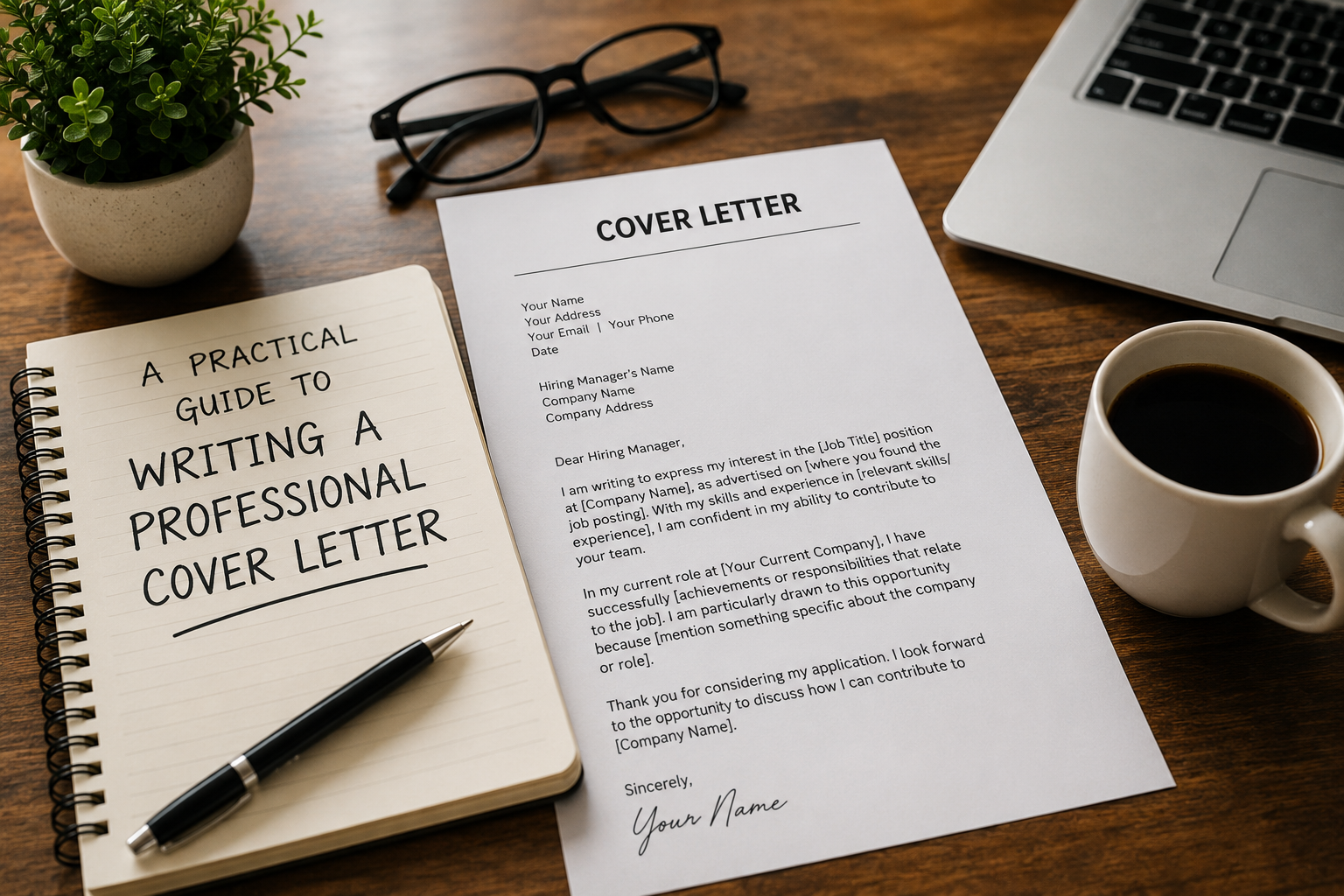
A Practical Guide to Writing a Professional Cover Letter
Introduction: Why Cover Letters Still Matter in 2026
Let's be honest. Writing a cover letter can feel like a chore. You've already spent hours perfecting your resume. Why do you need to write yet another document?
Here's the reality check: a well-written cover letter can be the difference between landing an interview and getting lost in the shuffle. In fact, 8 out of 10 recruiters report they make hiring decisions based on what they read in a cover letter.
Think of it this way: your resume tells an employer what you've accomplished. Your cover letter tells them why you did it and how you'd fit into their team. It's your chance to show personality, motivation, and genuine interest in the role.
Even if a job posting doesn't explicitly request a cover letter, sending one sets you apart from candidates who skip it. It demonstrates professionalism, attention to detail, and sincere interest in the position.
Ready to write a cover letter that actually gets noticed? Let's break it down step by step.
Chapter 1: Before You Start Writing – Do Your Homework
The biggest mistake candidates make? Writing a generic letter and simply changing the company name. Employers can spot this from a mile away.
Here's what you need to do before typing a single word:
- Read the Job Description Carefully: Highlight the required skills, responsibilities, and keywords that appear multiple times. These aren't just random words – they're clues about what the employer truly values.
- Research the Organization: Understand their mission, values, products, and recent achievements. Visit their website, read their "About Us" page, check their LinkedIn, and see what employees are saying.
- List Your Relevant Experiences: Think about jobs, internships, classes, projects, and activities that align with what the employer wants. Identify 2-3 of your strongest examples that match their needs.
- Find the Hiring Manager's Name: Whenever possible, address your letter to a specific person. LinkedIn, the company website, or a quick call can help you find this. If you can't find it, "Dear Hiring Manager" or "Dear Hiring Committee" is acceptable.
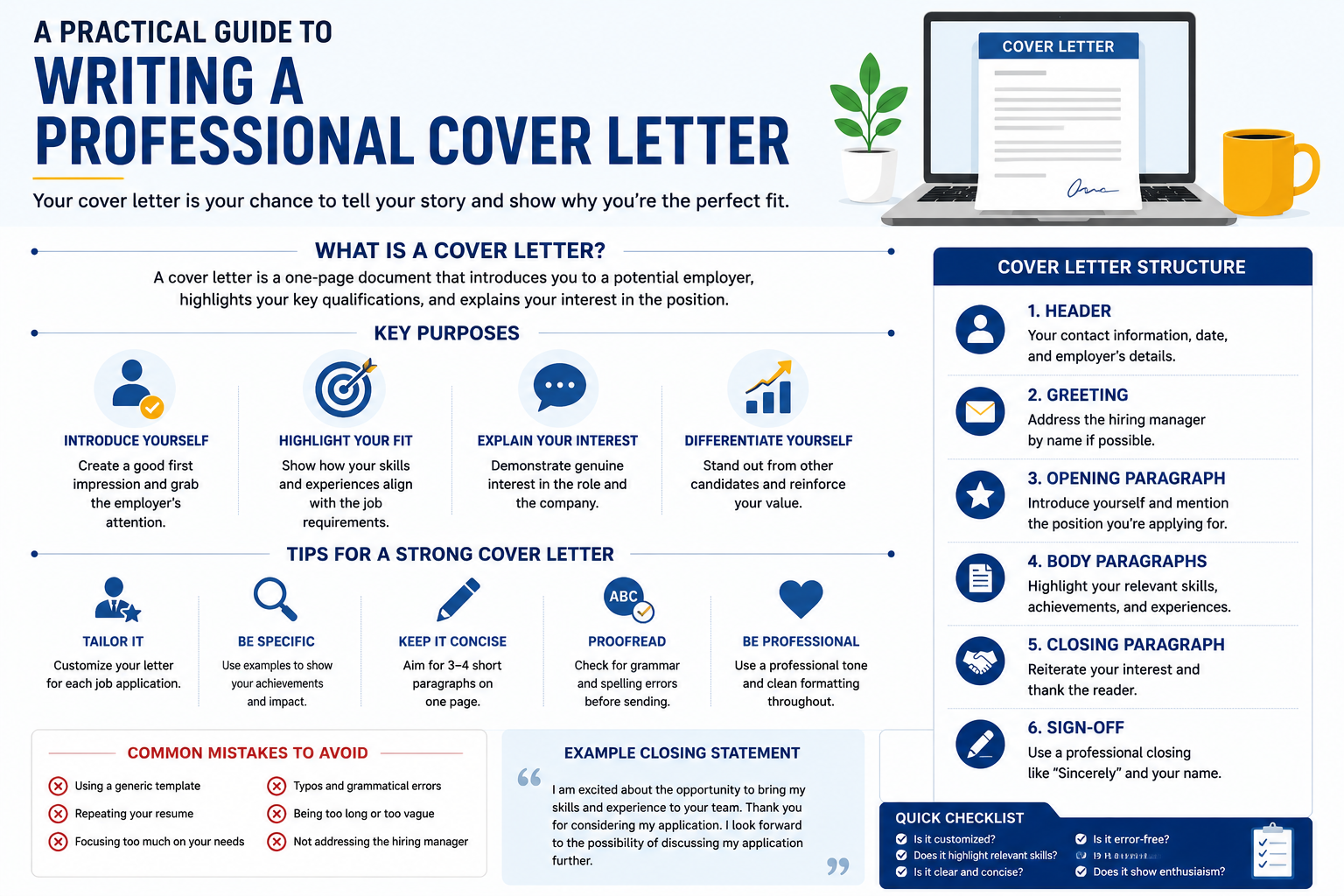
Chapter 2: The Structure – A Simple 3-Part Formula
Most professional cover letters follow a straightforward three-part format:
| Section | Purpose | Length |
|---|---|---|
| Opening Paragraph | Introduce yourself, state the position, explain why you're interested | 1 short paragraph |
| Body Paragraph(s) | Highlight 1-2 relevant experiences using specific examples | 1-2 paragraphs |
| Closing Paragraph | Reiterate interest, thank the reader, suggest next steps | 1 short paragraph |
Keep it to one page. Aim for 250-400 words. Hiring managers are busy – respect their time by being concise.
Chapter 3: The Opening Paragraph – Hook Them Immediately
Your first paragraph must grab attention. State exactly what position you're applying for and why you're excited about it.
Here's what to include:
- Who you are (briefly – "I'm a recent graduate in Marketing" or "I'm a software developer with 5 years of experience")
- The position you're applying for
- How you found the opportunity (mention a referral if you have one)
- Why you're interested in this company (be specific – mention something unique about them)
"As a marketing professional who has spent four years building B2B content strategies, I was excited to see the Senior Marketing Manager role at ABC Company. The focus on data-driven decision-making and SaaS growth aligns perfectly with my experience leading a team that increased organic traffic by 45%."
❌ Weak example (avoid this): "I am writing to apply for the position I saw on your website. I think I would be a good fit because I have relevant experience."
Chapter 4: The Body – Show, Don't Just Tell
This is where you prove your value. Don't repeat your resume. Instead, elaborate on a couple of key achievements and connect them to the employer's needs.
Use the STAR Method: The STAR method helps you structure compelling examples:
The context – what was happening?
What were you responsible for?
What did YOU specifically do?
What happened because of your actions? Use numbers!
"During my internship at the Community Food Bank, I noticed that our client check-in process was creating long wait times. [S] I took the initiative to design a new digital sign-in system and trained volunteers on how to use it. [T & A] As a result, average wait times decreased by 30%, and volunteers reported that the new system was much easier to use." [R]
Include Measurable Results: Numbers make your achievements concrete.
- Weak: "I improved customer satisfaction."
- Strong: "I improved customer satisfaction scores from 3.2 to 4.7 out of 5 within six months."
Chapter 5: The Closing – End with Confidence
Your conclusion should be short and forward-looking.
What to include:
- Reaffirm your enthusiasm for the role
- Mention how your strengths align with their needs
- Thank them for considering your application
- Express your desire for an interview
- Include your contact information (email and phone number)
"I would welcome the opportunity to discuss how my background in content strategy could support ABC Company's growth. Thank you for your time and consideration. I look forward to hearing from you."
Chapter 6: Professional Sign-Off – Keep It Simple
End with a professional closing: Sincerely, Best regards, Kind regards, Respectfully.
Then add your typed name below.
Chapter 7: Formatting – Make It Look Professional
Your cover letter should be clean, consistent, and easy to scan.
| Element | Recommendation |
|---|---|
| Font | Professional 11-12 pt font like Arial, Calibri, Times New Roman, or Helvetica |
| Margins | 1 inch on all sides |
| Spacing | Single-spaced with a space between paragraphs |
| Alignment | Left-aligned (do NOT indent paragraphs) |
| Length | One page (250-400 words) |
| File Format | PDF (preserves formatting) |
| File Name | FirstName_LastName_CoverLetter.pdf |
Chapter 8: Common Mistakes to Avoid
| Mistake | What to Do Instead |
|---|---|
| Generic opening | Lead with specific qualifications or why this role excites you |
| Repeating your resume | Add context and tell a story about your achievements |
| Typos and grammar errors | Proofread carefully – errors look unprofessional |
| Focusing on what you want | Focus on what YOU can do for the EMPLOYER |
| Long, rambling paragraphs | Keep it short and scannable |
| Using AI without editing | AI can help brainstorm, but rewrite in your own voice |
Chapter 9: Sample Cover Letter Template
Chapter 10: FAQ – Your Burning Questions Answered
Conclusion: Your Cover Letter is Your Story
Writing a strong cover letter takes effort. But here's the truth: the effort pays off.
Your cover letter is your chance to show employers who you really are – not just a list of bullet points, but a person with passion, skills, and a story. It connects the dots between your experience and their needs, and it demonstrates that you've taken the time to understand their organization.
Remember:
- Customize every letter for each position
- Use specific examples with numbers
- Show enthusiasm and confidence
- Proofread carefully (get someone else to check it too!)
- Keep it to one page
A well-written cover letter makes the reader want to meet you. And that's exactly what you need to land the interview.
Now go write that letter. Your future employer is waiting. 🚀