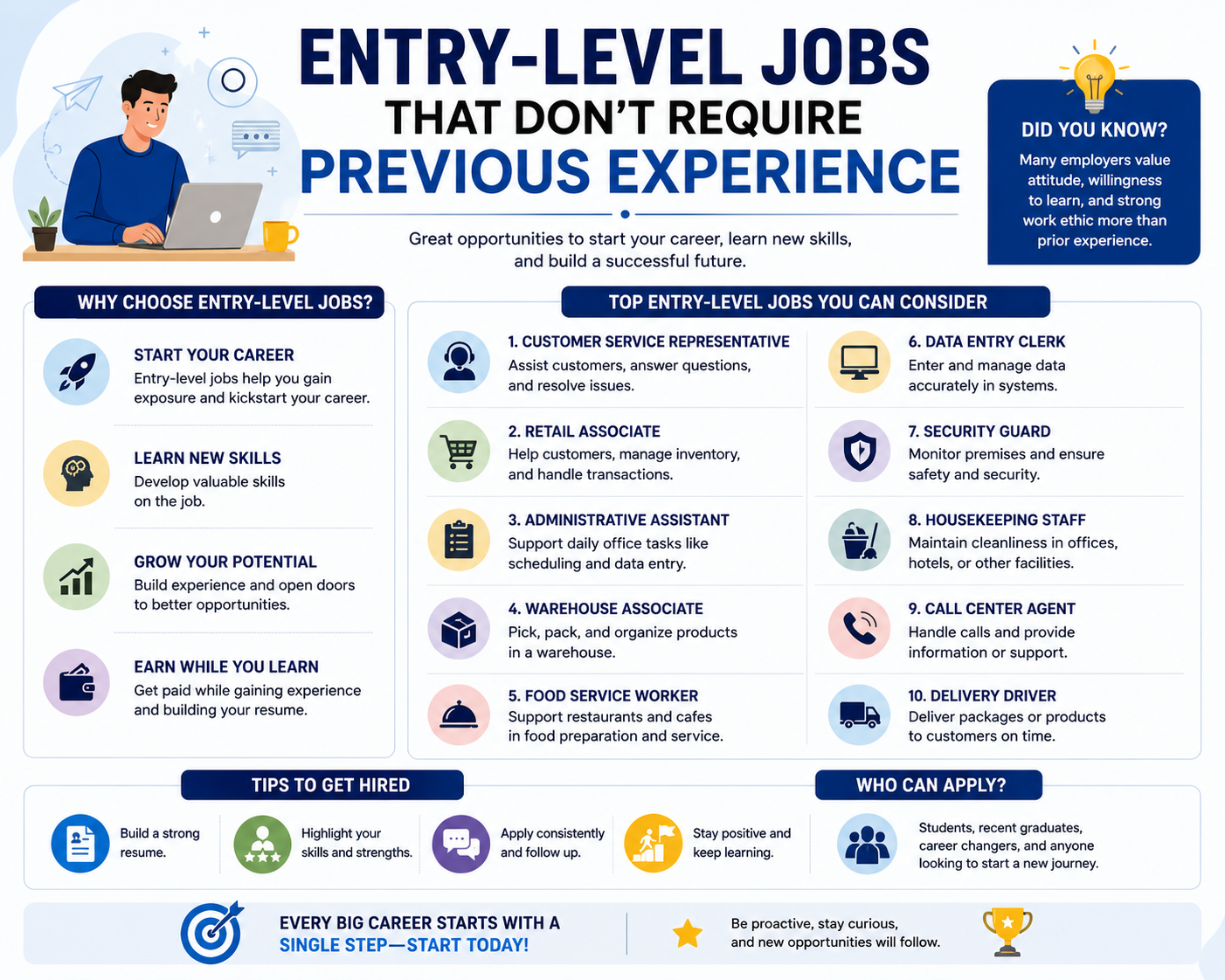
Entry-Level Jobs That Don't Require Previous Experience – Your 2026 Guide
Introduction: The Experience Paradox Is Real
You've heard it a thousand times: "Entry-level position available. Requires 2-3 years of experience." It's frustrating, it's confusing, and it makes you wonder how anyone is supposed to get started.
You're not imagining this. The "experience-required-for-entry-level paradox" is one of the most complained-about realities in today's job market, and for good reason. A lot of companies have quietly inflated their requirements, slapping "entry-level" on roles that are anything but.
But here's what's also true: genuinely experience-free entry-level jobs do exist. Real ones. Roles where employers expect you to show up without a professional track record and are prepared to train you. You just need to know which roles to target and where to find them.
This guide will show you exactly what "no experience required" actually means, which industries are most welcoming, and the specific roles you can apply for right now.
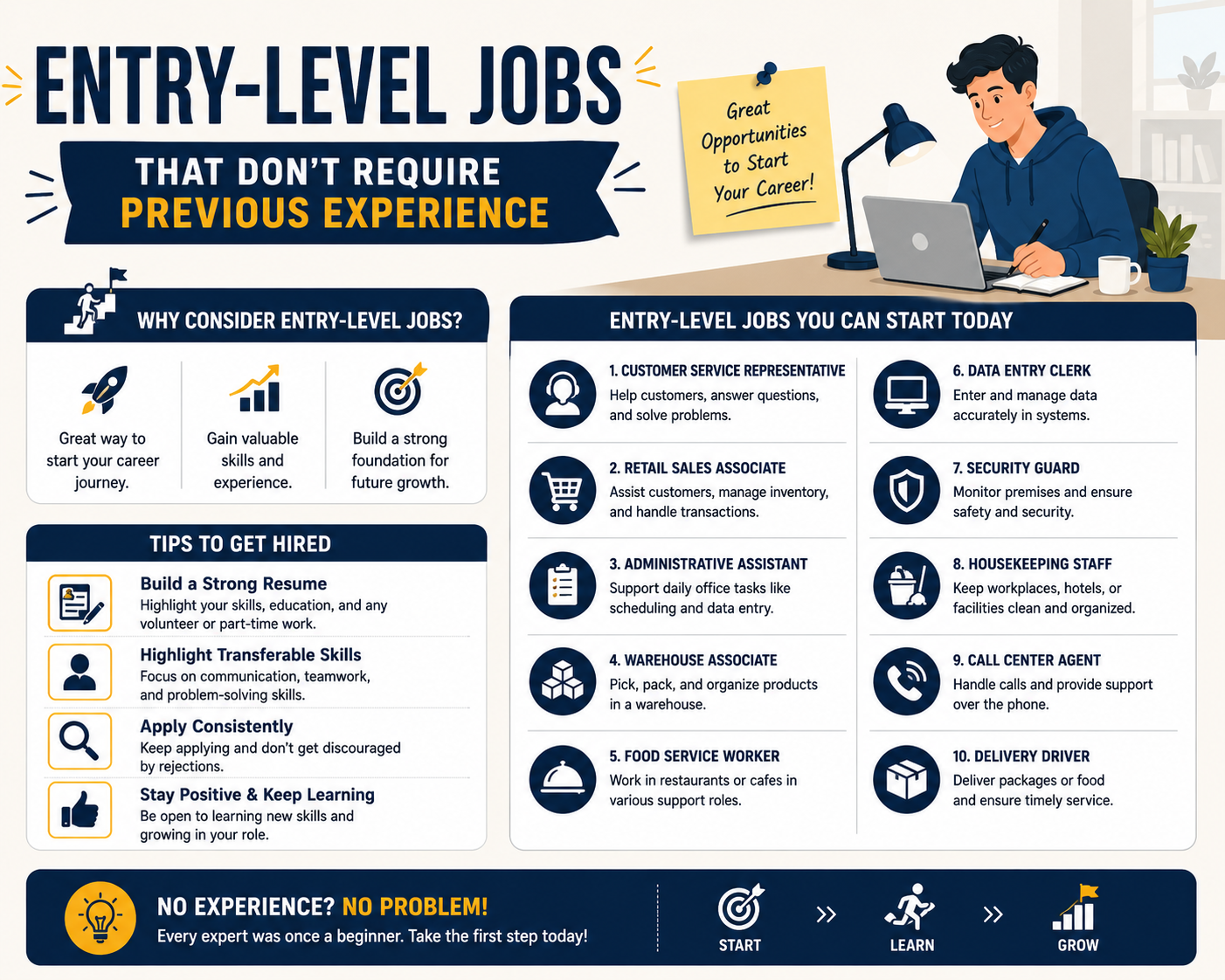
Chapter 1: What "No Experience Required" Actually Means
Let's be precise before diving in. "No experience required" doesn't mean employers want nothing from you. It means they're not expecting prior paid, full-time work in that specific role.
What Employers Are Actually Looking For:
| What They Want | What It Means |
|---|---|
| Transferable skills | Communication, organization, problem-solving |
| Relevant coursework | Class assignments count more than you think |
| Soft skills and attitude | Coachability, curiosity, reliability |
| Internships or volunteer work | Even informal experience signals initiative |
What Employers Really Think: Many businesses prefer to train employees themselves rather than recruit people with existing habits and experience from other employers. This is particularly common in retail, hospitality, warehousing, customer service, and care sectors.
The truth is, if you can demonstrate reliability, punctuality, good communication skills, a positive attitude, and willingness to learn, you may be able to secure a job even without previous employment experience.
Chapter 2: Which Industries Are Most Open to Beginners?
According to the U.S. Bureau of Labor Statistics, these industries typically require no formal education or prior work experience:
Hand laborers, material movers
On-the-job training provided; physical work valued
Food preparation, serving workers
High demand; willing to train from scratch
Retail salespersons, cashiers
Customer service focus; training provided
Janitors, building cleaners
Reliability valued over experience
The UK Job Market: In the UK, retail remains one of the largest employment sectors and provides opportunities for thousands of first-time workers every year. The care sector also continues to face staffing shortages and often recruits applicants without previous experience.
Chapter 3: 25 Entry-Level Jobs That Genuinely Don't Require Experience
Here are specific roles where employers are ready to train you from day one:
Sales & Business Development
Prospect leads, make outreach calls, set up meetings. Companies train from scratch.
💡 Why it works: High demand, clear career ladder, performance-based growth
Identify new opportunities, research prospects, initiate conversations.
💡 What you need: Strategic thinking and communication
Speak with customers, answer questions, promote products.
💰 Average salary: $52,371
Reach out to potential clients to arrange consultations.
💰 Average salary: $40,775
Customer Service & Support
Onboard users, answer questions, help clients get value from products.
💡 Common industries: SaaS, fintech, healthcare tech
Assist clients via phone, email, or chat.
💰 Average salary: $45,864
Handle customer calls, answer questions, resolve issues.
💰 Average salary: $42,860
Assist customers through messaging platforms.
💰 Average salary: $43,579
Troubleshoot issues, guide users, document solutions.
💡 Most companies provide full product training
Marketing & Content
Coordinate campaigns, schedule social posts, pull performance reports.
💡 Show genuine curiosity about the brand
Manage social media, assist with email campaigns, conduct research.
💰 Average salary: $52,584
Manage posts, respond to followers, track engagement.
💰 Average salary: $54,642
Schedule content, engage with followers, monitor trends.
💡 Club Instagram or personal brand experience counts
Write clearly and adapt voice to different audiences.
💡 Build a small portfolio before applying
Review written material for grammar, clarity, and consistency.
💰 Average salary: $51,295
Administrative & Office
Manage calendars, coordinate logistics, handle correspondence.
💡 Leads to broader opportunities within an organization
Enter information into databases, update records, handle clerical tasks.
💰 Average salary: $41,156
Schedule interviews, manage candidate pipelines, handle administrative work.
💡 Learn how hiring works from the inside
Handle email management, scheduling, research, social media support.
💰 Average salary: $50,502
Guide new hires through orientation and training remotely.
💰 Average salary: $53,675
Tech & Creative
Design bootcamp grads and self-taught designers with a portfolio can land junior roles.
💡 A portfolio is required
Evaluate websites, apps, or products before launch.
💰 Average salary: $68,400
Assist with social media graphics, ads, or branding materials.
💰 Average salary: $53,910
Gather data, summarize findings, support senior researchers.
💰 Average salary: $63,686
Troubleshoot software, hardware, or connectivity issues.
💰 Average salary: $58,478
Chapter 4: Quick Certifications That Open Doors
You don't need a degree to get started. These certifications can be completed in hours or days and immediately qualify you for more roles:
2-4 hours
$15-25
All food service, hospitality
8 hours
$180
Restaurant management
3-4 hours
$38-55
Bartending, serving
1-2 days
$60-150
Warehouse (+$3-5/hr)
10 hours
$25-89
Construction, warehouse
4 hours
$40-80
Any role (bonus)
Chapter 5: Where to Look for These Jobs
Job Boards and Platforms:
| Platform | Best For |
|---|---|
| Upwork, Freelancer, Fiverr | Short gigs—writing, admin support, research, data entry |
| Amazon Jobs Portal | Customer support, virtual assistant roles (filter by "remote") |
| Rev, TranscribeMe, Scribie | Transcription jobs |
| FlexJobs, We Work Remotely, Remote OK | Curated remote opportunities |
| General job search with "entry-level" filters |
Best Employers for First-Time Workers:
- Warehouse/Fulfillment: Amazon Fulfillment Centers, UPS, FedEx Ground, Target Distribution, Walmart Distribution
- Hospitality: Major hotel chains (Marriott, Hilton, Hyatt), event venues, catering companies
- Retail: Target, Walmart, Costco, grocery chains (Kroger, Publix), Home Depot, Lowe's
Chapter 6: How Many Applications Should You Send?
With no experience, volume matters. Here's a realistic guide:
| Experience Level | Applications Needed Per Week |
|---|---|
| No experience | 15-25 per week |
| Some experience | 10-15 per week |
| Experienced | 5-10 per week |
FAQ – Your Burning Questions Answered
Conclusion: Your First Job Is Waiting
The "experience paradox" is a challenge, but it's not an impossible one. Thousands of employers across industries regularly hire people with no previous experience. They're looking for attitude, reliability, willingness to learn, and communication skills—not a polished resume.
Remember these key takeaways:
- "No experience required" means they're willing to train the right person
- Transferable skills from school, volunteering, and life count
- Certifications can be completed in days and open doors
- Focus on high-demand industries: warehouse, hospitality, retail, customer service
- Apply to 15-25 jobs per week when starting out
- Start small, learn fast, and grow your career
Your skills got you here. Your first opportunity is waiting. Now go apply. 🚀