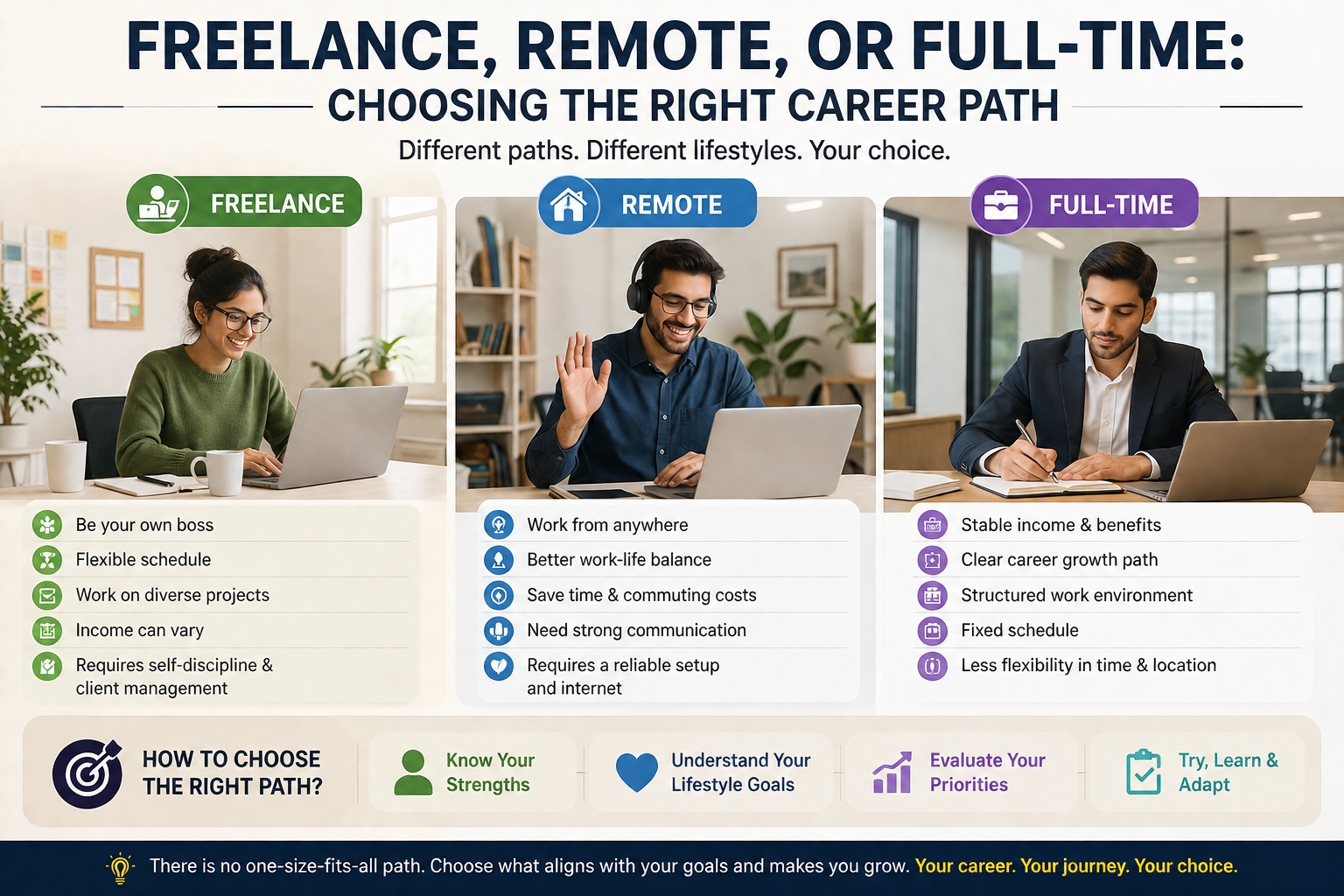
Freelance, Remote, or Full-Time: Choosing the Right Career Path – Your 2026 Guide
"Which path is right for me?"
It's one of the biggest questions professionals face in 2026. The answer isn't about which is "better" — it's about which is better for you.
The employment landscape has transformed. Remote work is now a normal negotiating lever for many roles. Companies are allocating a larger share of work to contract and project talent. And professionals have more options than ever before.
Here's the truth: Freelance vs full-time isn't a lifestyle debate anymore. It's a career design decision. Both paths can work — but for different people, at different life stages.
Chapter 1: The Core Difference
A full-time employee trades time and skills for a fixed monthly salary, benefits, and job security.
What you get: Fixed monthly salary, employer PF and ESI contributions, structured mentorship, a clear designation ladder, and paid leave.
What you give up: Freedom to choose your projects or hours, and salary growth typically capped at 6-10% annually.
A freelancer trades time and skills for project-based income, complete schedule control, and the ability to work with multiple clients simultaneously.
What you get: You set your rates, choose your clients, work when you want, and there is no ceiling on your income.
What you give up: No fixed monthly income, no employer benefits, client acquisition takes real time and energy, and tax filing is more complex.
Remote work can be either full-time employment or freelancing, but with location flexibility. It's a work arrangement, not a career path.
What you get: Work from anywhere, better work-life balance, save commuting costs.
What you give up: Strong communication needed, reliable setup required.
Chapter 2: The Income Reality
This is where most people get the comparison wrong. They compare the headline freelance rate to a full-time salary without accounting for what each actually costs.
| Factor | Full-Time Employee | Freelancer |
|---|---|---|
| Monthly income | Fixed, predictable | Variable, project-dependent |
| Income taxes | Employer deducts TDS | You file ITR-4, deduct expenses |
| PF contribution | Employer contributes 12% | You contribute 100% yourself |
| Health insurance | Often employer-provided | You pay out of pocket |
| Paid leave | 12 to 24 days per year | No paid leave at all |
| Equipment and tools | Often employer-provided | You pay for everything |
| Income ceiling | Capped by band and appraisal | Uncapped, grows with reputation |
That said, a senior freelancer in a high-demand niche earning ₹2,50,000 per month is genuinely earning far more than most equivalent full-time roles.
Chapter 3: Work-Life Balance and Lifestyle
The Freelancer Rhythm:
- Total flexibility: Work anytime, anywhere
- Variable workload: Want to work 50 hours this week and take next week off? Your call
- Choose your clients: Difficult client? Fire them
The Full-Time Employee Rhythm:
- Structured schedule: Most companies expect 4-6 hours of overlap with the team's primary time zone
- Meetings are non-negotiable: Stand-ups, 1:1s, team syncs, all-hands
- PTO requires approval: Even generous policies have an approval process
Chapter 4: Benefits and Job Security
The Full-Time Advantages: Employer-provided health insurance, paid time off, retirement contributions, and professional development budgets can add 25-40% to the value of an employment package.
Full-time employees also enjoy greater job stability. Organizations invest in training and onboarding new employees, making them less likely to let go of full-time staff than short-term contractors.
The Freelance Reality: Freelancers pay for everything themselves:
- Health insurance: ₹20,000-50,000 annually for individual coverage
- Retirement: No employer match — every rupee comes from your pocket
- Unpaid time off: Every sick day, every holiday, every slow Tuesday costs you
- Business overhead: Accounting software, liability insurance, legal fees, invoicing tools
Chapter 5: Career Growth
The Employee Path:
- Clear levels: Junior, mid, senior, staff, lead, director
- Mentorship is built in: Working under experienced leaders accelerates development in ways freelancing rarely matches
- Cross-functional exposure: You learn how a business works, not just your corner of it
- Resume weight: Three years at a respected company signals depth and reliability
The Freelance Path:
- Deep specialization: Freelancers who niche down often develop deeper expertise than generalist employees
- Business skills by necessity: You learn sales, pricing, client management, accounting, and marketing
- Portfolio breadth: Working with 8 clients across 4 industries builds a more diverse portfolio
- The referral flywheel: Strong work leads to referrals, which leads to higher rates, which leads to better clients
Chapter 6: Which Industries Support Which Path?
Freelancing: Strong, mature freelance market
Full-Time: Strong, with remote options
Freelancing: Very strong, project-based work
Full-Time: Strong for in-house roles
Freelancing: Strong for experienced professionals
Full-Time: Strong for structured careers
Freelancing: Limited, mainly consulting
Full-Time: Dominant
Freelancing: Very limited
Full-Time: Dominant
Chapter 7: The Hybrid Approach
You don't have to pick one permanently.
Keep your full-time job. Take freelance projects on nights and weekends. This lets you:
• Build a client base before depending on freelance income
• Test whether you actually enjoy selling and managing clients
• Save a 6-month financial runway before making the jump
Land one or two long-term retainers that cover baseline expenses, then fill remaining capacity with higher-rate project work. Best of both worlds: stability plus upside.
Many companies offer 3-to-6-month contract roles that convert to full-time. You get to test the company's culture, the team, and the work before committing.
Chapter 8: The Decision Framework
Answer these 7 questions honestly:
- How Much Runway Do You Have? Less than 3 months of savings? Freelancing is high-risk. Get a full-time job, save aggressively, and revisit in a year. Six or more months saved? You have enough buffer to absorb the income swings of early freelancing.
- How Do You Handle Ambiguity? Freelancing means making hundreds of small decisions every week. If that sounds energizing, freelancing fits. If it sounds exhausting, full-time structure will serve you better.
- Do You Need Benefits? If a partner's employer covers your health insurance, the freelance benefits gap shrinks. If you are covering your own health, dental, vision, and retirement, the cost adds up fast.
- Where Are You in Your Career? Early career (0-5 years): Full-time roles generally deliver more value through mentorship, structured learning, and resume credibility. Mid-to-senior (7+ years): You have the expertise and network to make freelancing viable and lucrative.
- Are You Actually a Self-Starter? Do you finish personal projects without external deadlines? Do you maintain habits without accountability partners? Freelancing demands self-direction in every area.
- Does Your Field Support Freelancing? Research the freelance market in your specific field before assuming you can replicate your salary.
- What Are You Optimizing For? Freedom? Freelancing. Stability? Full-time.
Income: Freelancing – Variable, uncapped ceiling | Full-Time – Fixed, predictable
Flexibility: Freelancing – Complete control | Full-Time – Limited, set hours
Job Security: Freelancing – None | Full-Time – High
Benefits: Freelancing – Self-funded | Full-Time – Employer-provided
Career Growth: Freelancing – Self-directed | Full-Time – Structured path
Decision-Making: Freelancing – You decide everything | Full-Time – Decisions made for you
Best For: Freelancing – Self-starters, risk-takers | Full-Time – Those who value stability
FAQ – Your Burning Questions Answered
Conclusion: Your Career, Your Choice
The freelancing vs full-time debate has no universal winner. Full-time employment offers stability, benefits, and structured growth. Freelancing offers autonomy, flexibility, and higher income potential for those who manage risk well.
One honest signal: imagine a slow month with no guaranteed income. If that thought paralyzes you, full-time is probably right for now. If it motivates you to hustle, freelancing might be your natural environment.
The right choice depends on your priorities, financial planning, and lifestyle goals. With realistic expectations and disciplined execution, either path can support a successful career.