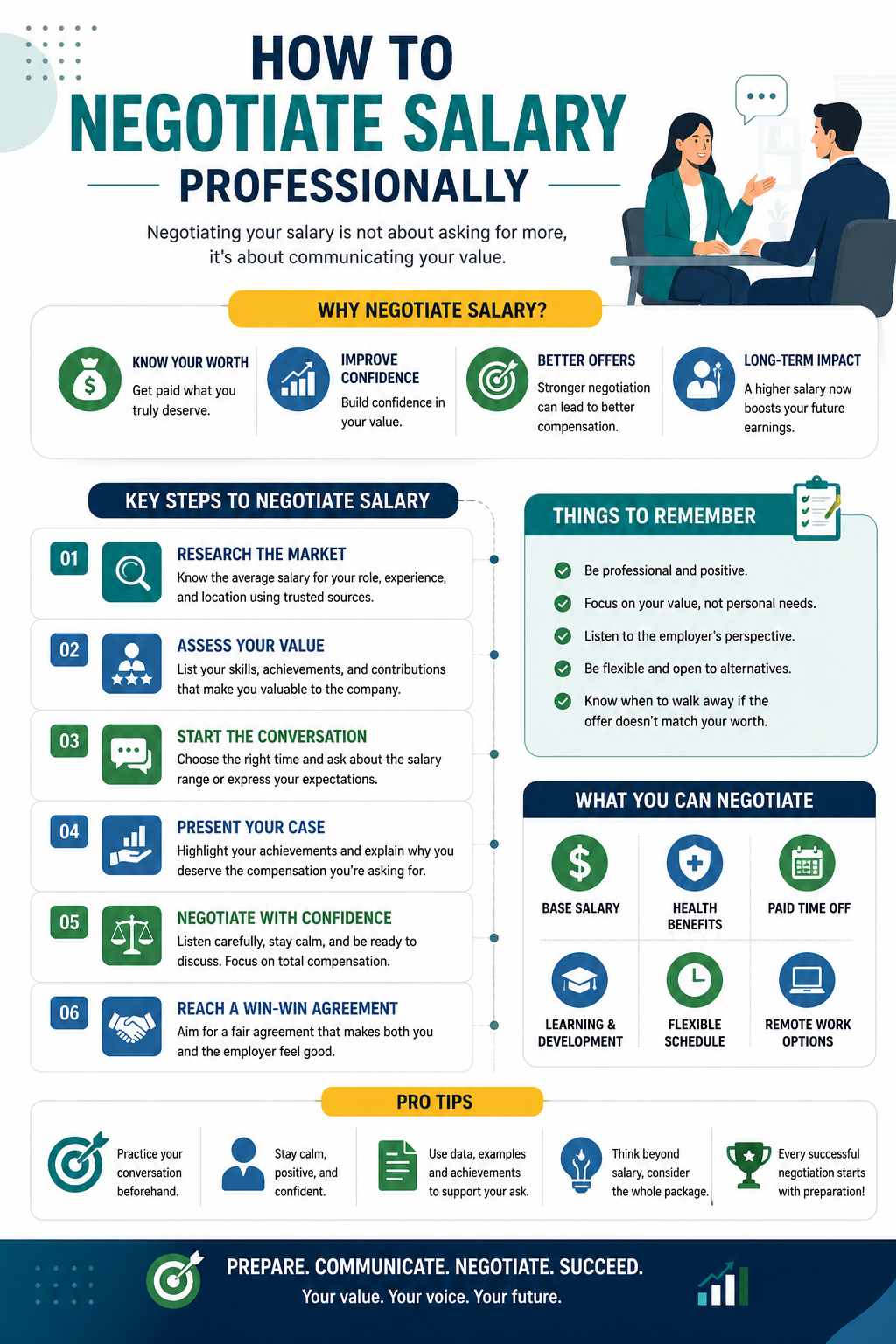
How to Negotiate Salary Professionally – The 2026 Guide
Introduction: Why You Must Negotiate
You've aced the interviews. The company loves you. And now, the offer is on the table. You feel a wave of relief – and maybe a little disappointment at the number staring back at you.
Here's the truth: most job offers are not final offers. Employers expect you to negotiate. In fact, failing to negotiate can cost you more than just money. It can impact future raises, bonuses, and career growth for years to come.
The statistics are sobering:
- 64% of job seekers accept the first number offered
- Nearly 60% of professionals aged 45-54 admit they don't negotiate at all
- People who negotiate their salaries can, on average, increase their salary by over 7%
This guide will walk you through exactly how to negotiate your salary professionally – from research to the final handshake.
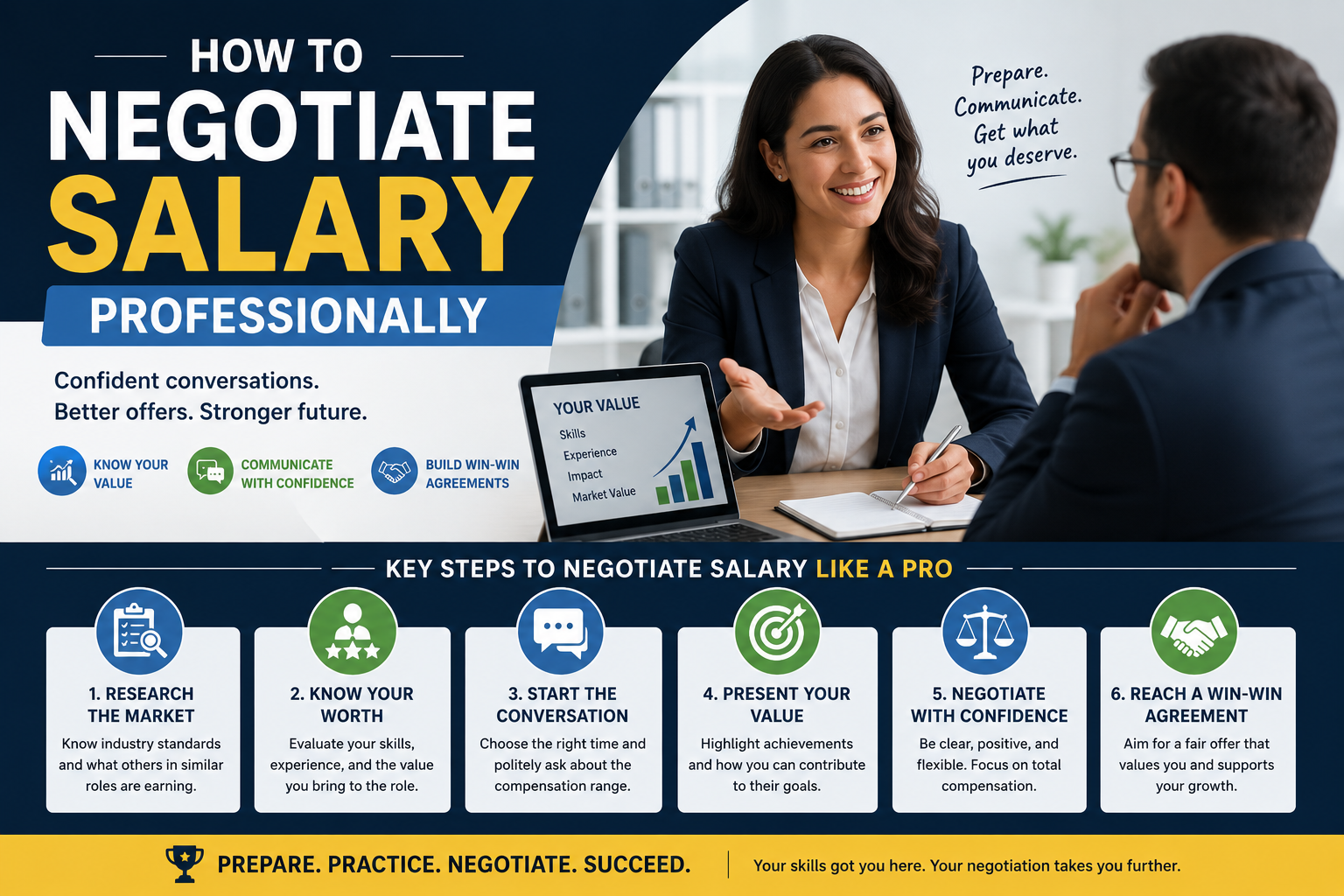
Chapter 1: Do Your Homework – The Research Phase
Preparation is the foundation of any successful negotiation. You can't negotiate effectively if you don't know what you're worth.
Understand Your Market Value: Start by consulting reputable compensation tools to benchmark your role. Platforms like Payscale, Glassdoor, Salary.com, LinkedIn Salary, and the U.S. Bureau of Labor Statistics offer salary data filtered by job title, years of experience, industry, skills, and location.
What to consider:
- Your years of experience in this field
- Geographic location (salaries vary based on cost of living)
- Company size (larger companies often have bigger budgets)
- Your specific skills and qualifications
Tap Into Your Network: Beyond digital sources, your network can be invaluable. Reach out to trusted peers, mentors, or former colleagues to gather firsthand insight into what comparable professionals are earning. These conversations often reveal real-world nuances that static data can't capture.
Establish Your Range: Before the conversation, you need three numbers in mind:
Your walkaway number based on financial needs and professional worth
Example: $65,000
A realistic, data-backed figure that aligns with the role and your experience
Example: $70,000
Typically 5-15% above your target to give yourself room to negotiate
Example: $75,000-$78,000
Chapter 2: Timing – When to Make Your Move
The golden rule: Only negotiate after you've received a formal job offer.
Why This Matters: Until you have an offer, you don't have real leverage. Before that point, the employer hasn't fully committed to you. Once they've extended an offer, they've already invested time and energy in you. They want you on board, which gives you bargaining power.
What to Do When Asked Early About Salary: If a recruiter asks about salary expectations during an interview, avoid giving a specific number too early. Here are phrases that work:
"Based on my research, similar roles in this market typically fall between $X and $Y. I'd be glad to discuss what makes sense for this specific opportunity."
"I'm sure there's a good match between my skills and interests and the salary range you are working with. Could you share information about the salary range set for this position?"
After Receiving the Offer: Don't say "yes" immediately. Take time to consider the offer. It's perfectly professional to say:
Most employers will give you a deadline of a couple of days or a week. Use this time to prepare your counteroffer.
Chapter 3: Know Your Worth – Build Your Case
Numbers alone don't win negotiations – evidence does.
Identify Your Unique Value: Come prepared with a list of your top achievements, ideally supported by measurable outcomes. Think:
- Revenue impact
- Cost savings
- Operational efficiencies
- Team leadership wins
- Projects you've delivered
Quantify Your Impact: The more you connect your past results to the strategic needs of the role you're pursuing, the stronger your negotiating position becomes.
Know the Employer's Needs: Before negotiating, try to understand the employer's perspective:
- What are their needs for this role?
- What problem are they hiring you to solve?
- How might recruiting you benefit the company strategically?
Understanding this helps you frame your counteroffer as a benefit for them, not just a demand for you.
Chapter 4: The Conversation – How to Negotiate Professionally
Start with Enthusiasm: Begin by expressing genuine excitement about the role. This sets a positive and collaborative tone.
State Your Counteroffer with Confidence: Then, clearly and professionally state your expectations:
Use the Power of Silence: Don't fill the silence. After making your case or counter-offer, pause. Giving the other party space to respond is not just respectful – it's often a powerful negotiation tool.
Keep the Focus on Value, Not Personal Needs: Avoid bringing up personal financial needs like student loans or rent. While these may be genuine concerns, they are not valid justifications for an employer to increase your salary. Focus on your qualifications and the value you bring to the organization.
Ask Questions Instead of Making Demands: Facilitate negotiations in good faith by posing a request as a question:
Chapter 5: When They Say "No" to More Money
Sometimes, base salary truly isn't negotiable. But that doesn't mean you're out of options.
Explore the Total Compensation Package: Salary is just one piece of the puzzle. A compensation package can also include:
Signing bonuses, annual bonuses, performance-based incentives
Stock options, restricted stock units
Additional paid time off, vacation days, sick leave
Remote work, hybrid arrangements, flexible hours
Tuition reimbursement, professional development budget, certifications
Health insurance, 401(k) match, life insurance
If the salary offer is non-negotiable, calculate how much these additional benefits are worth to you. Sometimes, a lower salary plus excellent benefits can be a better deal than a higher salary with limited perks.
Chapter 6: The Art of the Counteroffer
When you're ready to respond, here's a step-by-step approach:
- Step 1: Thank Them – Always start with gratitude. This maintains a positive relationship.
- Step 2: State Your Research – Share what you've found regarding market rates.
- Step 3: Highlight Your Value – Remind them why you're worth the investment.
- Step 4: Ask for Your Target – Clearly state your counteroffer.
"Thank you again for this offer. I'm very excited about the role and what I can bring to the team. Based on my research and my experience in [specific area], I was hoping we could discuss a base salary of [$Initial Ask]. I believe this better reflects the value I'll bring to the organization."
Practice Makes Perfect: Rehearse your pitch with a friend, mentor, or career coach. Practice will make you more articulate and ready for any surprises during the conversation.
Chapter 7: Handling the Back-and-Forth
Negotiations rarely end after a single exchange. Here's how to navigate the process:
If Budget Constraints Are Mentioned:
If They Come Back with a Lower Number: Consider this: Is it closer to your target? Can you meet somewhere in the middle? Remember your minimum acceptable number. If they're below it, you can try one more time:
Know Your BATNA: BATNA stands for Best Alternative to a Negotiated Agreement. Knowing you have options—like other job offers—gives you confidence and leverage. Having multiple offers or the ability to say "no" is extremely powerful.
Chapter 8: Get It in Writing
Once you've reached an agreement, ask for the full offer in writing. This should include:
- Base salary
- Any bonuses or incentives
- Key benefits
- Your official start date
Clear documentation helps prevent misunderstandings and ensures both parties are aligned on expectations.
Chapter 9: What If You Need to Walk Away?
Sometimes, the negotiation process will not reach a satisfactory outcome. If the final offer doesn't meet your minimum acceptable salary or falls short in critical areas, it's appropriate to decline politely.
"Thank you again for the offer and for taking the time to discuss it with me. While I'm genuinely interested in the role, the compensation package isn't quite aligned with my expectations at this time. I truly appreciate your time and consideration."
Important: Never ghost an employer. Stepping away respectfully signals confidence in your value and leaves the door open for future opportunities.
Chapter 10: Common Mistakes to Avoid
| Mistake | Why It Hurts | What to Do Instead |
|---|---|---|
| Accepting the first offer | Leaves money on the table; 64% of candidates do this | Always counteroffer |
| Sharing salary history | Weakens your position; illegal in many states | Redirect to market value |
| Bringing up personal needs | Not a valid business reason for a raise | Focus on skills and value |
| Being aggressive or entitled | Damages the relationship before it starts | Be confident, not demanding |
| Not having a number | Shows you're unprepared | Research and set targets |
| Giving a range too wide | They'll likely anchor to the low end | Give a tight, researched range |
| Not practicing | You'll sound less confident | Rehearse with a friend |
FAQ – Your Burning Questions Answered
Conclusion: You Deserve to Be Paid Fairly
Salary negotiation isn't about being pushy or greedy. It's about advocating for your professional worth. And despite what your nerves might tell you, it's expected. Most employers see it as a natural part of the hiring process and a sign of professionalism.
Remember these key takeaways:
- Prepare: Research your market value, know your numbers, and build your evidence
- Wait for the offer: Don't negotiate until they've committed to you
- Lead with gratitude: Show enthusiasm while advocating for yourself
- Focus on value: Frame your request around what you bring, not what you need
- Think beyond base salary: The total compensation package includes benefits, equity, and perks
- Practice: Rehearse your pitch with a trusted friend
- Stay professional: Be firm but polite throughout the process
- Know when to walk away: If the offer doesn't meet your minimum requirements, it's okay to decline respectfully
As one career expert put it: "No one will advocate for your worth more than you. You don't get what you are worth, you get what you negotiate."
Now go get what you deserve. 🚀