The Skills Employers Value Most Across Industries – Your 2026 Guide
Introduction: The Skills Landscape Has Shifted
Here's a truth that might surprise you: job titles matter less than ever. What actually gets you hired in 2026 is what you can do, not what your last designation was. The global workforce is undergoing a fundamental shift, driven by artificial intelligence, automation, and changing business needs. Employers are looking less at degrees and more at capabilities.
Across industries, two broad categories of skills are emerging as critical: human-centric skills (communication, leadership, adaptability) and technical skills (AI literacy, data analysis, cybersecurity). According to a 2026 survey of hiring managers, 62% said hard skills and soft skills are equally valuable, while 24% said soft skills matter more.
This guide breaks down exactly what employers want, backed by data from leading sources like the World Economic Forum, LinkedIn, and Coursera. Whether you're a student, career changer, or experienced professional, these insights will help you prioritize your learning and stand out in the job market.
Chapter 1: The Big Picture – What 2026 Data Reveals
The World Economic Forum's Findings: According to the World Economic Forum's Future of Jobs Report 2025, based on surveys of over 1,000 employers representing 14 million workers globally, analytical thinking is the most important core skill, cited by 69% of employers. Right behind it is resilience, flexibility, and agility (67%), followed by leadership and social influence (61%) and creative thinking (57%).
The report also projects that 39% of workers' core skills will change by 2030, making continuous learning essential. 170 million new jobs are expected to be created this decade, while 92 million roles will be displaced – a net gain of 78 million jobs.
LinkedIn's Skills on the Rise 2026: LinkedIn's analysis of over a billion profiles reveals that people skills matter more than ever. Leadership, cross-functional collaboration, team management, and mentorship are increasingly in demand. Communication skills, especially public speaking and executive stakeholder communication, have become critical as technology reshapes how we work.
AI goes beyond coding – demand for technical AI skills like prompt engineering and large language models is growing, alongside AI business strategy skills as companies integrate AI into core products and services. Risk and compliance management skills are also rising as regulatory environments become more complex.
Coursera's Job Skills Report 2026: Coursera's data from nearly six million enterprise learners shows GenAI remains the most in-demand skill in the platform's history, with 14 enrollments per minute. However, learners recognize that AI skills are most powerful when layered on top of core technical competencies like SQL and JSON.
Crucially, critical thinking and validation skills are now recognized as core competencies. Enrollments in critical thinking grew by 168% for Data learners and 185% for GenAI learners year-over-year. As workers offload tasks to AI, the human role shifts from collaborator to expert validator of final output.
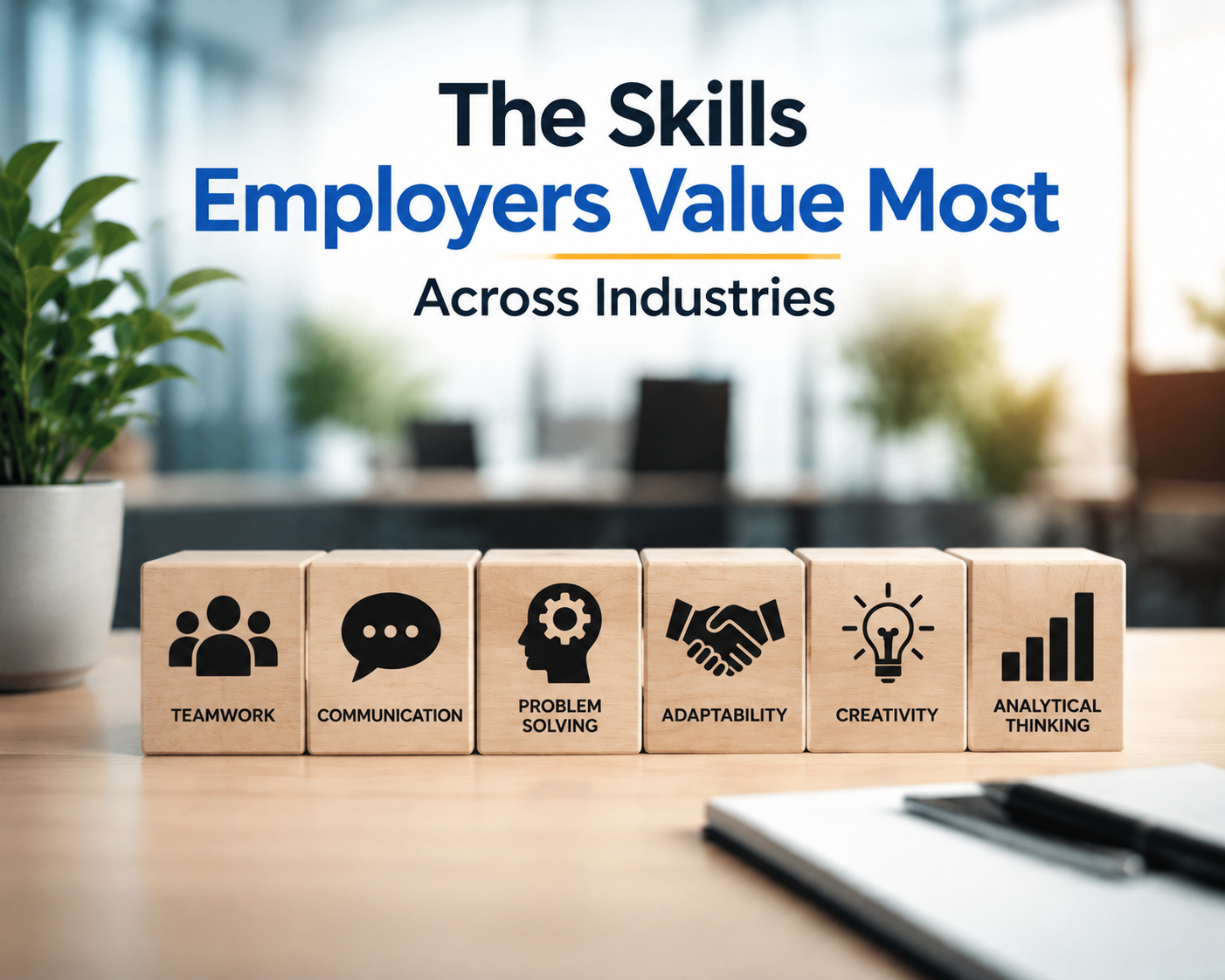
Chapter 2: The Top Human Skills Employers Want
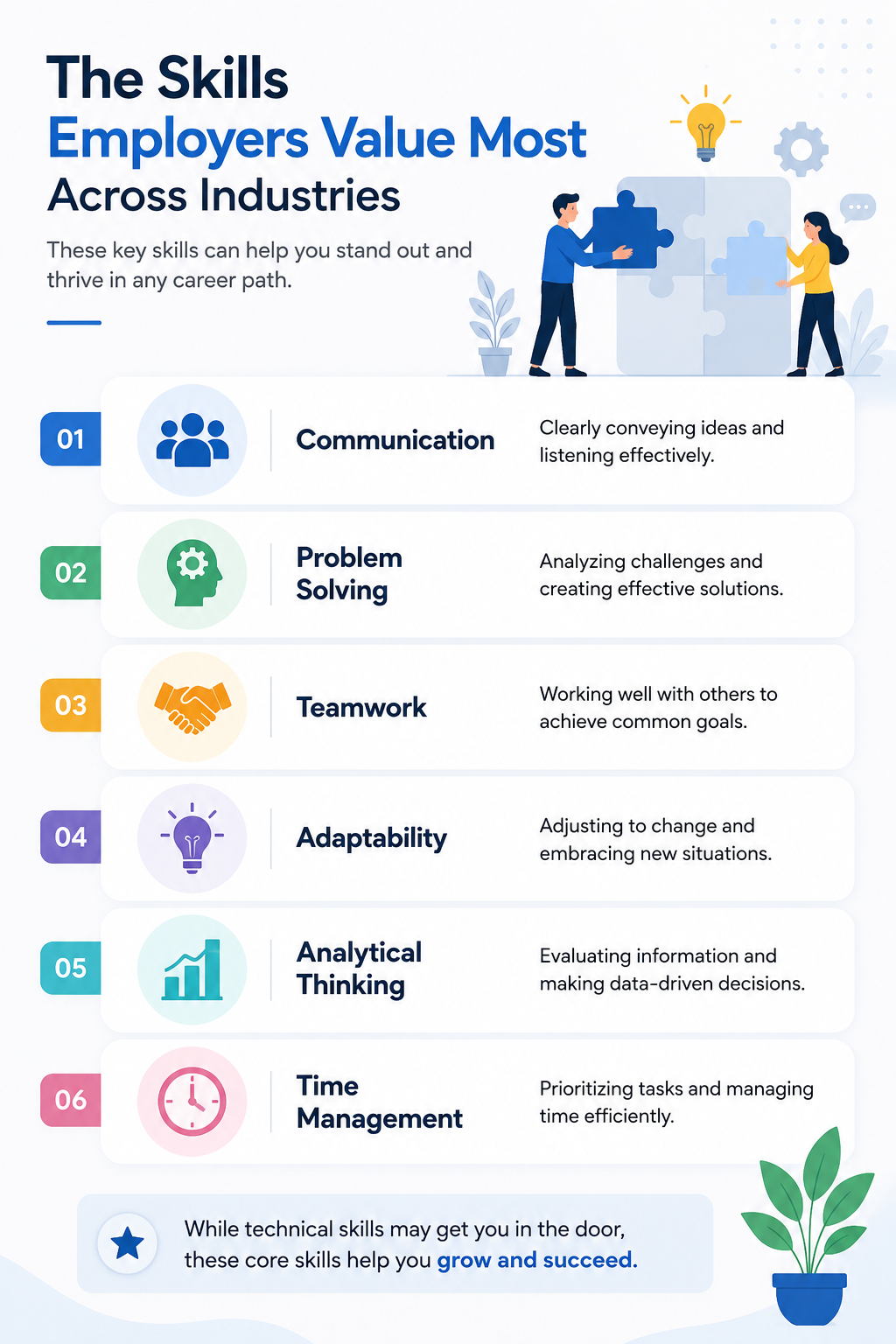
Unquestioned #1 across all reports. Public speaking, clear writing, and executive stakeholder communication are directly highlighted in job descriptions. Bridges the gap between technical output and business impact.
Not just for managers. Includes mentoring, leading projects, training others, and helping teams navigate challenges. Ranked 3rd most important by WEF (61%).
With AI reshaping industries, the ability to bounce back and adapt is crucial. WEF ranks it 2nd most important (67%). View change as opportunity, not threat.
Read a room, respond constructively to feedback, build relationships. Cornerstone data shows 95% year-over-year growth in demand. Human skills like empathy and judgment become differentiators.
Evaluate information, question assumptions, design solutions without a clear playbook. WEF ranks analytical thinking as #1 (69%). Coursera shows over 100% growth in enrollments.
Core business skill – organizations need fresh ideas and new ways of working. WEF ranks creative thinking 4th (57%). Build by tackling open-ended projects and collaborating across disciplines.
Chapter 3: The Top Technical Skills in Demand
1. AI and Machine Learning Literacy: AI is no longer a niche topic. GenAI remains the most in-demand skill globally. Cornerstone reports AI and machine learning skills grew 245% year-over-year. PwC's 2026 Global AI Jobs Barometer found jobs requiring AI skills have grown 69% since 2019 – almost eight times faster than the overall job market. The average wage premium for AI skills has reached 62%.
2. Data Analysis and Data Literacy: Organizations need people who can make sense of data. Hiring managers rank data analysis as a top hard skill for 2026. Coursera data shows over 100% year-over-year growth in Data Quality (+108%) and Data Cleansing (+103%).
3. Cybersecurity Awareness: With cyberattacks increasing, basic cybersecurity awareness is central for nearly every role. Cornerstone reports cybersecurity skills grew 31% year-over-year.
4. Cloud Computing: Essential for remote operations, scalability, and digital transformation. Cornerstone reports 85% year-over-year growth.
5. Project Management: Valuable in nearly every industry. Hiring managers rank project management as a top hard skill for 2026. Experience leading initiatives, coordinating volunteers, or managing complex projects all count.
Chapter 4: How Skills Priorities Vary by Industry
Retail, Hospitality, Healthcare
Top Skills: Customer Service, Active Listening, Communication, Service Orientation, Emotional Intelligence, Patience
Finance employers value problem-solving, analytical, and critical thinking skills
Top Skills: Creative Problem Solving, Critical Thinking, Communication, Growth Mindset, Service Orientation
Blended skills profile – strong demand for leadership, project management, and problem-solving combined with elevated interest in data analytics, programming, and AI
Focus on consistency and precision, often done through teams
Top Skills: Communication, Analytical Thinking, Creative Problem Solving, Emotional Intelligence, Growth Mindset
Chapter 5: How Skills Priorities Vary by Company Size
| Company Size | Top Skills |
|---|---|
| Small (Under 100) | Communication, Customer Service, Active Listening, Emotional Intelligence, Empathy |
| Mid-Size (101-5,000) | Communication, Critical Thinking, Analytical Thinking, Growth Mindset, Service Orientation |
| Large (5,001-25,000) | Communication, Critical Thinking, Service Orientation, Justice, Emotional Intelligence |
| Enterprise (25,001+) | Customer Service, Communication, Creative Problem Solving, Service Orientation, Growth Mindset |
Chapter 6: The "Professionalized" vs "Democratized" Divide
PwC's 2026 Global AI Jobs Barometer reveals a two-speed jobs market:
Professionalized roles – where AI handles routine tasks but relies heavily on human expertise and judgment (e.g., radiologists, recruiters) – have seen job growth at twice the rate of democratized roles, with salaries rising 42% faster.
Democratized roles – where AI makes it easier for less experienced workers to perform tasks (e.g., IT service managers, medical secretaries) – are growing more slowly.
What this means for you: Developing high-level judgment, leadership, and communication skills can position you in the "professionalized" category where both job growth and salaries are stronger.
Chapter 7: The Entry-Level Reality
PwC's analysis of 2.4 million entry-level jobs in the US found that positions most exposed to AI are now seven times more likely to require skills traditionally associated with more senior staff – including leadership, creativity, and interpersonal communication.
Demand for these entry-level roles has increased by 35% since 2019, while vacancies for other entry-level jobs have fallen by 10%. This suggests employers increasingly expect junior staff to demonstrate higher-level skills earlier in their careers.
Chapter 8: Skills That Are Declining
As AI and automation take over standardized tasks, routine and repetitive skills are declining. Areas shrinking include:
- Basic data entry
- Telemarketing
- Basic customer service
- Administrative support skills
Chapter 9: What This Means for You – Actionable Takeaways
- Don't Choose – Blend Both: The most successful professionals combine technical and human capabilities. Develop AI literacy and data skills alongside communication, leadership, and adaptability.
- Focus on "Future-Ready" Skills: Future-ready skills stay useful even as specific job titles and tools change. These include analytical thinking, creative problem-solving, social and emotional intelligence, and comfort working with AI-powered tools.
- Build Your Skills Portfolio: Take courses – enrollments in professional certificates have increased by an average of 91% across career areas. Practice through volunteering, community groups, and stretch assignments. Tell stories around your skills – share when you used them and what impact you created.
- Ask Others for Feedback: For those unsure about their strengths, ask colleagues, friends, or even volunteer groups what they think you're good at. Often, others will repeat the same strengths, helping you identify core capabilities.
FAQ – Your Burning Questions Answered
Conclusion: Your Skills Are Your Future
The job market in 2026 rewards professionals who can blend human judgment with digital capability. The days of relying on a single degree or job title are over. What matters now is what you can actually do.
Remember these key takeaways:
- Human skills – communication, leadership, emotional intelligence – are more valuable than ever
- Technical skills – AI literacy, data analysis, cybersecurity – are essential across industries
- Adaptability is non-negotiable – 39% of core skills will change by 2030
- Continuous learning is the new baseline – invest in verified credentials and certifications
Your skills travel with you. They're not fixed for life – you can always develop new ones. The question isn't whether you have the right skills today. It's whether you're committed to building them for tomorrow.
Now go invest in yourself. Your future employer is waiting. 🚀